
Ford County Court Records After Arrest
Ford County criminal cases are handled in the 11th Judicial Circuit at the Ford County Courthouse. The court-record path usually runs from arrest, to booking at Ford County Jail if custody is required, to prosecutor review, to the court filing that becomes the case record. The Ford County Circuit Clerk is the records office for the local case file, and official court pages link Ford County users to Judici for online case and docket access where public access is allowed.
Jail and court records answer different questions. A jail record can help confirm current custody, booking date, arresting agency, receive or release time, and related booking information. A court record after a jail arrest shows the filed charges, case number, docket activity, hearings, orders, disposition, and sentencing if the case reaches that point. For custody and booking details, use Ford County jail inmate records; for booking-photo issues, use Ford County jail mugshots.
Ford County Judici Court Records
The Illinois Courts Ford County Courthouse page links to Online Records through Judici Ford County. During research, the Judici landing page showed navigation for Home, Cases, Docket, Premium Services, and login or account functions, while the deeper case and docket pages prompted human verification. That means Ford County court records after arrest should be searched from the public Judici entry point, but the exact fields can depend on the verification step and current Judici interface.
Judici's Ford County court page is the official online entry point identified by the Illinois Courts courthouse directory.
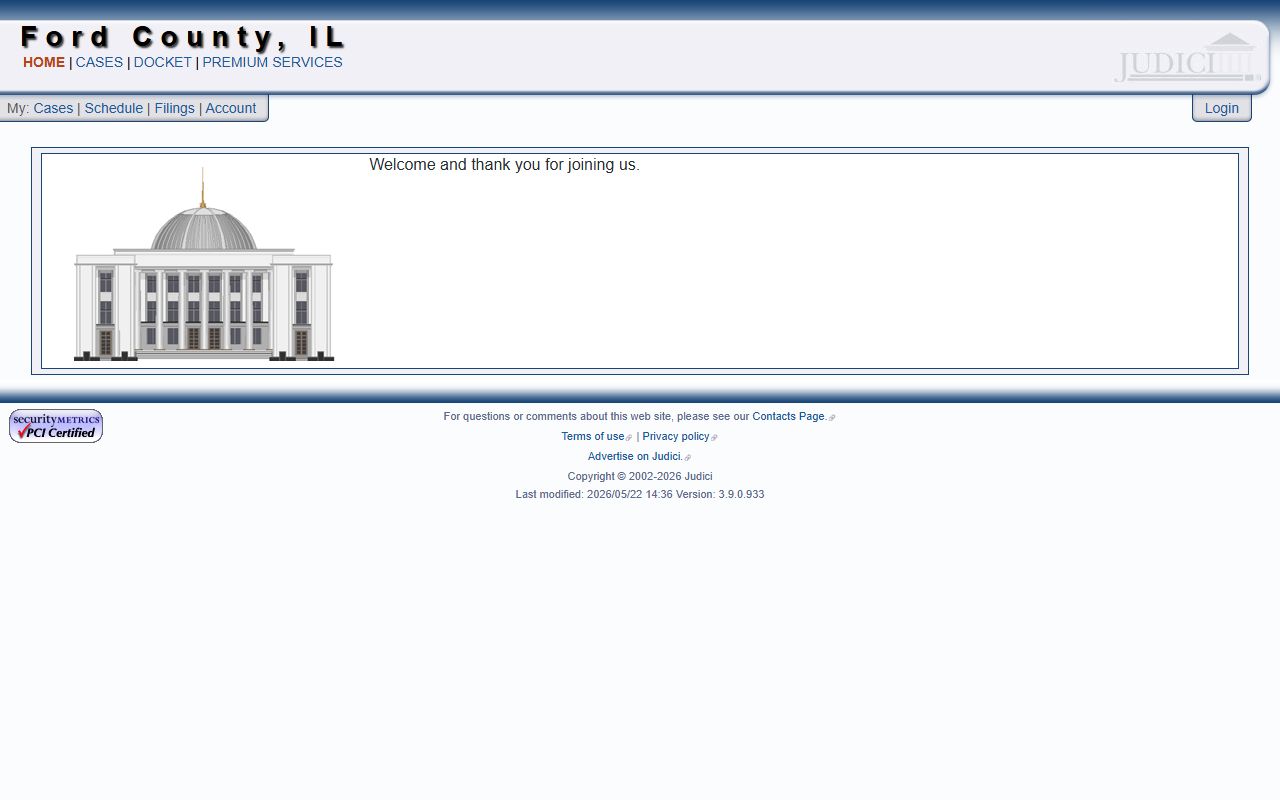
The Judici page matters because the court record is where filed charges and docket activity appear after the jail booking stage.
| Judici Area | Type | Required | Use for Ford County Records |
|---|---|---|---|
| Cases | Navigation tab or link | Verification may be required | Search public case records after an arrest when the case has been filed. |
| Docket | Navigation tab or link | Verification may be required | Check scheduled court dates and docket entries when public. |
| Premium Services | Subscriber tools | Account may be required | May provide added access for eligible or paying users. |
| Login / Account | Account link | Optional for some public entry, required for account services | Access can vary by role, record type, and Judici rules. |
Find Court Records After Arrest
Ford County court records after a jail arrest should be checked by name and case information where the portal allows it. A person may be booked before the filed case appears online, so a same-day search can miss a newly filed or not-yet-filed matter. If the case is not online, contact the Ford County Circuit Clerk, Kasi Schwarz, at 200 W. State Room 106, Paxton, IL 60957. The clerk's phone is (217) 379-9420, and the office hours are 8:30 AM-4:30 PM.
- Open Judici from the Ford County or Illinois Courts online-records link.
- Complete any human verification required by Judici before using cases or docket tools.
- Search by the available defendant-name, case-number, or docket options shown by the site.
- Open the case and read each count, charge level, next hearing, order, and disposition line.
- If the public portal does not show the case, call or visit the Circuit Clerk for public-access options and older-record routing.
Statewide document access may also be available through re:SearchIL, but access depends on account status, user role, document permissions, and record type. It should be treated as a document-access system, not a replacement for the Ford County Circuit Clerk's local case record.
Ford County Arrest Charging Records
The Ford County State's Attorney, Andrew L. Killian, is the prosecutor who reviews arrests and files or pursues criminal charges in court. Illinois uses the title State's Attorney, not District Attorney. The office is at 200 W. State Room 204, Paxton, IL 60957, with phone (217) 379-9460 and fax (217) 379-9464. A jail booking charge is a starting point, but the filed court charge controls the criminal case record.
| Document | What It Is | How It Affects the Court Record |
|---|---|---|
| Complaint | An initial sworn charging document or allegation, often used early in a case. | Can start the public criminal case and list the first charged count. |
| Information | A charging document filed by the prosecutor without a grand-jury indictment. | Often states the formal count the State's Attorney is pursuing. |
| Indictment | A grand-jury charging document. | May replace or frame charges in more serious felony matters. |
Ford County Charge Status Records
Charges can change after a jail arrest. Police may book a person on one suspected offense, but the prosecutor may file a different charge, reduce a count, add a count, dismiss a count, or decline to proceed. For that reason, court records after arrest are the right place to verify the charge status. The docket and case record should be read count by count because one case can contain several charges with different outcomes.
| Status | Meaning in a Ford County Court Record |
|---|---|
| Pending | The charge has not reached final resolution. |
| Amended | The prosecutor or court record changed the charge language, count, or cited offense. |
| Reduced | The charge was lowered to a less serious offense or count. |
| Dismissed | The charge was removed by the prosecutor or court. |
| Nolle prosequi | The prosecutor declined to proceed on that charge. |
| Conviction | A guilty plea, guilty verdict, or other final finding of guilt. |
| Sentence | The penalty imposed after conviction. |
Pretrial Release After Arrest
Illinois cash bail ended on September 18, 2023. Ford County court records after a jail arrest should therefore be read with current pretrial-release terms in mind. The old question, "How much is bond?" may not match the court order. Judges now decide whether a defendant may remain released while the case is pending, whether nonfinancial conditions apply, or whether the prosecutor has met the requirements for pretrial detention in an eligible case.
A person can have a release order and still remain in custody if another hold exists. The Ford County Jail can house detainees for other jurisdictions, including the U.S. Marshals Service, so a court record should be compared with the jail's current custody explanation. Outside holds, warrants from another county, parole matters, federal detainers, ICE issues, or paperwork timing can affect release even when the Ford County case shows a change in status.
| Term | Ford County Practical Meaning |
|---|---|
| Cash bail | Former money-based release system; no longer used by Illinois courts as of September 18, 2023. |
| Pretrial release | Court-authorized release while charges are pending, with conditions when ordered. |
| Detention | Court-ordered custody pending case after the required legal process. |
| Conditions of release | Rules such as appearing in court, no contact, supervision, travel limits, or other orders. |
| Hold or detainer | Separate authority that may keep a person in jail after the local release question changes. |
Warrants After Ford County Arrest
No official Ford County active-warrant search, warrant list, or most-wanted page was located in the official sources reviewed. Warrant questions should be routed through the sheriff, court clerk, docket, and attorney channels. A bench warrant may appear in a public docket after missed court or failure to comply, but a search warrant is not an inmate lookup tool, and a fugitive warrant from another jurisdiction may lead to Ford County holding the person until transfer or further court action.
For immediate custody or warrant-related questions, call Ford County Jail or the sheriff at (217) 379-2324. For public-record process questions, use the sheriff administrative office at (217) 379-9470. For docket and case questions, contact the Ford County Circuit Clerk at (217) 379-9420 or search Judici after verification. Federal warrants and federal holds should be handled through defense counsel, federal court context, or the U.S. Marshals Service Central District of Illinois.
Charges vs Convictions
A Ford County arrest charge is not a conviction. An arrest shows that law enforcement took a person into custody or accused the person of an offense. A charge is the formal accusation being pursued in court. A conviction is a final result after a guilty plea, guilty verdict, or other finding of guilt. Public court records can show all three stages, but they should not be treated as the same fact.
| Point of Comparison | Charge | Conviction |
|---|---|---|
| Stage | Accusation filed or pursued in court. | Final guilty result by plea, verdict, or finding. |
| Proof | Not proof of guilt. | Reflects a final outcome unless later changed by appeal or post-judgment relief. |
| Where to verify | Judici, Circuit Clerk, and filed charging documents. | Court disposition and Illinois State Police conviction-history channels. |
| Use caution | May be amended, reduced, dismissed, or not pursued. | May still be subject to sealing, expungement, appeal, or later court action. |
Illinois Conviction Records
The Illinois State Police Bureau of Identification handles Uniform Conviction Information Act public conviction-information access. UCIA is not the same thing as a Ford County jail roster, a Ford County arrest report, or the Judici court docket. It is a statewide criminal-history route focused on public conviction information, not every arrest or every dismissed charge. For nonconviction court activity, the Circuit Clerk and case docket remain the better starting points.
Illinois criminal identification law also covers arrest fingerprints, photographs, charges, descriptions, and disposition reporting in specified systems. Sealing and expungement law can later limit public access to eligible arrest and court records. That means a public search result may change after a court order, and older case details may require clerk review rather than a quick online search.
Sealed and Expunged Records
Sealing and expungement are different remedies. Sealing generally limits public view of an eligible record while leaving it available to certain justice agencies or authorized users. Expungement is a stronger process that removes or treats an eligible record as though it did not exist for most public purposes. Eligibility depends on the charge, disposition, waiting period, prior record, and court order, so the public docket alone does not decide the issue.
| Point of Comparison | Sealed | Expunged |
|---|---|---|
| Public visibility | Hidden from most public searches. | Removed or treated as erased for most public access. |
| Record existence | The record still exists with limited access. | The record is removed or destroyed as the order directs. |
| Law enforcement access | May remain available to certain agencies. | Very limited access, depending on the order and law. |
| Common trigger | Eligible convictions or nonconvictions under Illinois law. | Eligible arrests, dismissals, acquittals, or other qualifying dispositions. |
Note: A sealed or expunged Ford County case may not appear the same way in Judici, clerk records, ISP records, and agency files.
Restricted Ford County Court Records
Not every court record after a jail arrest is fully public. Juvenile matters, sealed cases, expunged records, certain victim details, protected addresses, mental-health information, and records tied to active investigations can be limited or withheld under Illinois law and court rules. FOIA also allows criminal justice agencies to withhold some arrest details when disclosure would interfere with proceedings, endanger safety, or compromise correctional security.
The Ford County Circuit Clerk is the local point for public court-record access, while the sheriff's written FOIA channel handles sheriff or jail records. The State's Attorney prosecutes the case but does not replace the clerk as the court-record office. When the question involves release status, custody, or outside holds, compare the case docket with the jail before assuming the court record is the final custody answer.